Tuesday, October 9, 2012

Being Patience


Within a year of living in Bangalore, I have learned one thing above all else: patience—an ability to wait, most presumably. I have learned that life is not all about me. I have learned to look inward, not outward. I have learned to be patient with impatient people. I have grown up—horizontally and diametrically, probably. The horizontal part is undeniable. The diametrical part, I leave to your judgment.

I have a few friends who are impatient, arrogant, insensitive, and impulsive—traits that even affect their relationships altogether. Maybe it's also that I am not getting any younger. I tend to resist everything now. I get angry slower—or often never at all. I have the patience to wait. I am patient before opposing points of view. Previously, I was a patient of patience. I was in emotional upheavals, trying to change others before I changed myself. Now I have submitted under patience. Everything changes me, bringing me into the circle of the best humanity. I feel I am following one of the principles of the Buddha. To have patience is to have respect. And lately, I am viewed positively by many friends. Either that, or they are just too tired to argue with me.

I feel patience can be controlled by letting go of troubles and impatience completely, absolutely, totally—with no lingering feeling, just moving forth. If there isn't anything to resolve, just let it go. It's possible, and it's the only healthy thing to do. Accepting the twists and turns of life gracefully keeps my dreams realistic. Life is not always a race but a journey to be watched every step of the way. Patience works wonders with anger, nervousness, tension, and anxiety—though it does nothing for traffic jams. I'm still working on that.

I have changed my attitude and the way I look at life. I have always tried to have a positive outlook. Being positive is very imperative, as is possessing a sense of patience.

Once I was like a horrid river, rushing through hills and plains hurriedly, not listening to anyone. I was on my own way. My students tested my patience so many times, and the result was that they got black and blue. I vividly remember picking up a log and raining it on their backs. I regret that now. I feel sorry for losing such control, for being so crude and wild—wilder than hot dogs. "Sorry" seems to be the cruelest word now, because it can never undo what was done.

My child has also tested my real patience. But my anger changed into passive observation. I let him do what he liked and let it go. I have developed an ability to tolerate and persevere when things get tough between us. I have become a little anxious about how to keep calm. And I kept. Thank you, my dear son, for teaching me forbearance and serenity—and for not breaking anything too expensive.

My wife has also trimmed me down to a better person. A sort of passionate person is what I have become. Otherwise, I used to rant and rave and nag more than many women would have done. Now I am a cool lover of everything. Even cold coffee. Especially cold coffee.

I can now tolerate many things. I have learned patience through many means: patience in anger, patience in sadness, happiness, loneliness, and through every person who has walked through my life. This patience has helped me endure any tribulation, no matter how long-lasting or difficult. On the other hand, it reduces my stress levels and improves my health and wealth—I feel so, anyway. My bank account may disagree, but my blood pressure thanks me. Being able to have patience makes me happier. Thinking about the positive effects of patience kills impatience. Or at least puts it in a headlock.

So, patience is persistence. It takes time, and it takes effort. We are so accustomed to anger that we find the natural state of patience quite strange. However, impatience is an outside value we have adopted, but patience is an intrinsic value within all of us. We can change. Slowly. Very slowly. Patiently.

I would like to let loose my patience to write further, but instead I will leave you with this thought from Lao Tzu:

"I have just three things to teach: simplicity, patience, compassion. These three are your greatest treasures."

And if you ask me, the fourth treasure is a good cup of tea while you wait.

The Truth Is

From Google

Dear My Beloved

I asked you to care for me.

But the truth is:

I care about you more than anything in the world.

I asked you to love me.

No—I didn't ask.

But the truth is:

I love you more than anything in the world.

Dear, you are my all.

My everything.


Thursday, July 26, 2012

The Chuzom

Last time, on the way to Paro, I sneaked out of my car for a few minutes to see the Chuzom. I was saddened—almost defiled—to see these two rivers. Do they ever have clear and clean times? I would say a big 'NO' and a small 'yes,' because we humans are the tragic villains in their lives. Still, the Thimchu and Pachu are the Phochu and Mochu of Punakha—playthings and beautiful designs of God.
The Chuzom

Coming from the clear cavities,
glaciers of Tibet and Jomolhari,
the calm rivers of Thimphu and Paro
meet at Chuzom-
like lovers long decided.

I stand at the Chuzom confluence
and asked: What have you brought for your lover?
For they both come from the wealthiest Dzongkhags.
They only tickle a clatter
and move on-
Carrying the specter of urban decay and death,
a stagnant slate of all sorts and sizes
of unwanted things:
plastics, papers, tins, rubbers, bones, vegetable covers-everything.
Their faces were tainted with greases and oils.
They move on. uncomplaining.
Oh…no…
Coming from such rich places,
What have I to give you?

The two forces strengthen at Chuzom,
and their zeal moves on.
Crossing violence and serenities without a sojourn,
they run together toward their destination,
collecting what they never asked for.
Their only goal is the limitless sky of the ocean—
just as the grave is the only destination for man.


Tuesday, July 24, 2012

The Wonderla Trip

So far, I have made two short trips in Bangalore. Yes, two. In what feels like a lifetime of engineering lectures and mediocre hostel food, I actually managed to escape.

The first was with my classmates on 12th May, when we visited three legendary temples in Belur, Halebeedu, and Shravanabelagola, about 222 km from Bangalore. These were impressive historical temples—the kind that make you feel deeply spiritual for about five minutes before you start wondering where to buy snacks (for more info, click here: http://saachad9.blogspot.in/2012/05/trip.html). Also, 222 km is a suspiciously round number. I don't trust it.

The second trip was on 23rd August with some Bhutanese students to Wonderla. Wonderla is no wonderland for those who are physically crippled or handicapped—let's just get that out of the way. But we were not, so we bravely decided to test our luck and our stomach lining. We paid just ₹590 as entry fees, and once inside, all the games are free! Well, "free" after you've paid. But who's counting? (I am. Always.)

There are nearly 60 different types of nerve-racking attractions that are worth trying—provided you don't have a heart condition, a fear of heights, a fear of water, a fear of screaming strangers, or a recently eaten meal you'd like to keep down. It is truly an amusement park with lots of entertainment, ranging from land attractions to sky attractions. In other words, you can get terrified on solid ground or while suspended in mid-air. The choice is yours, and either way, you will scream like a small child.

To name a few: there are dungeon rides (great for pretending you're in a horror movie), Wonder Splash (great for getting wet whether you wanted to or not), Insanity (aptly named—whoever came up with it clearly hated humanity), a carousel (for the faint-hearted and the romantically inclined), a wave pool (where you can experience the ocean's fury without the risk of sharks), and a lazy river for "active people"—which is a hilarious contradiction, because if you're active, why are you floating lazily? The lazy river is for people who want to feel productive while doing absolutely nothing. I respect that.

I am posting some photos with some flippant descriptions. You have been warned. Look at our faces in each shot: before the ride (confident and foolish), during the ride (pure existential terror), and after the ride (triumphant, dizzy, and slightly nauseous). You're welcome.

Caution: If you want to use the images, please ask, don’t steal.
Journey to Wonderlaaa… a snapped from the car. Country road, take me home, to the place, where I …???


So it was the beginning… near the wonderla’s entrance. We took our first group photograph. That guy in a black shirt is looking for a cat. Ouch! And where is meee...? An old fox…at the extreme corner. Who is that man, he is up to necking in my three beloved!!!

Aahhaa…a singing lady pig!

Can you see a hanging monkey? Don’t hang around like the monkey, it’s just water. Water pendulum.

One of the high thrill rides. It is called Y-scream. It shakes you and mixes you like a blender. Do you know why it is called Y-scream? Because the clock is almost ticking to 12 below the sky wheel. It is the coming of the letter Z , the end!

Kwality or quality ice cream??? Foods in moving stalls. They say, they sell in MRP, but MRP has double once it has reached from the outside market. Cheee…aateeerrrrrsssss.

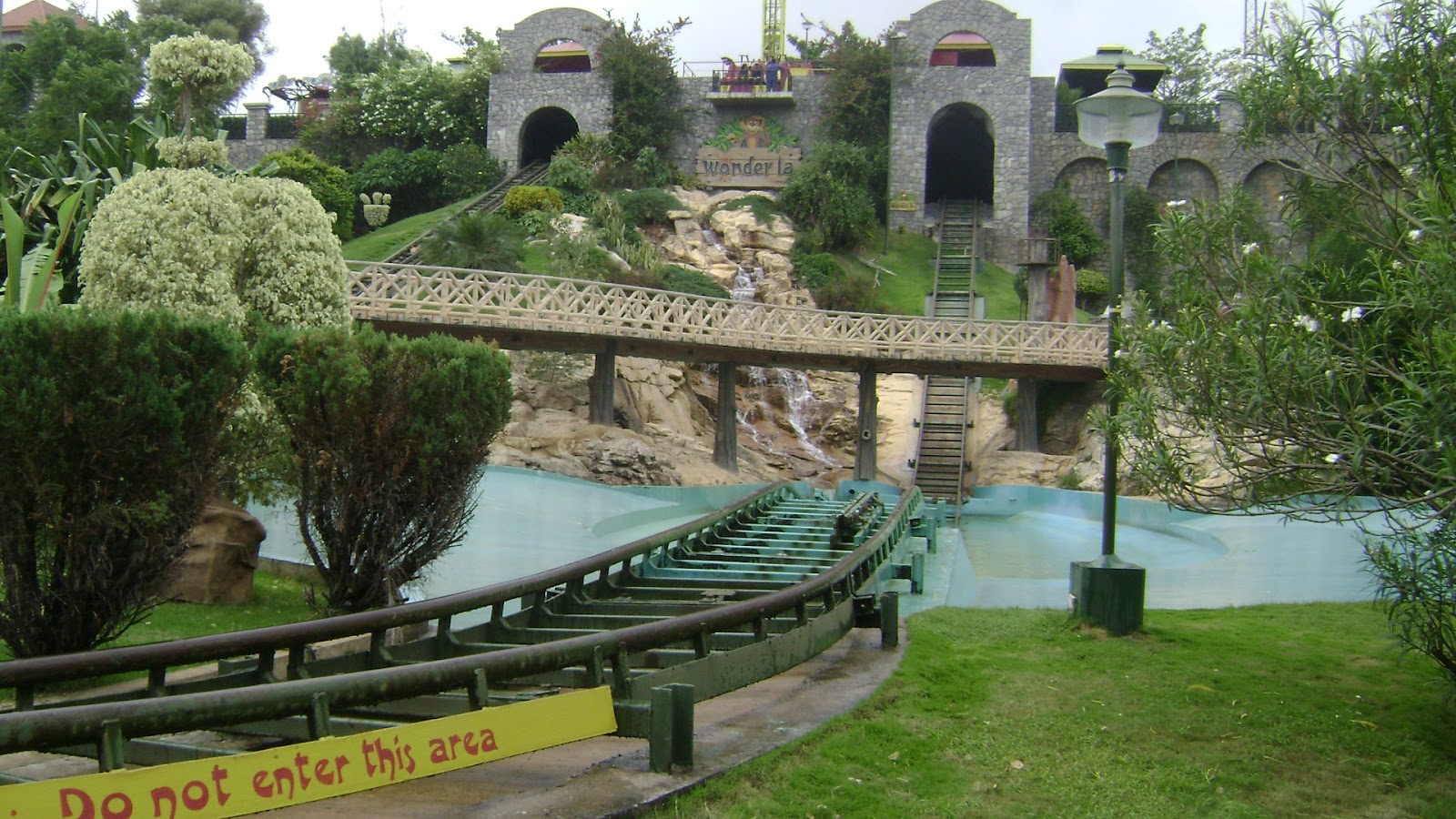
Coaster ride train tracks. This was the only game I liked the most; slow ride uphill and fast downhill ride- splashing. The journey of life is such; uphill and downhill. And this is the lesson I learned from there, uh, so early .

So this is the wonder splash--wooden train/boat.  Spot me...holding on tight. We used to make this type of boats-by chopping woods during cattle herding days. But I never thought it would come to life like this.


Two and two make-s…uhah…three?... Four? …No. Let me count from the very beginning. But I don't wanna see those boys' bums!


Azzai woy! The house of ghosts. Termite coaster and train inside, but there isn’t a single live termite inside. Then what type of termite is this? Just a human termite like me and the cement termite. Can you see that stomach piles coming out from the disfigured house? The piles were taken out from the Bhutanese girls. The fact is seen of a girl's bum slashing scathingly.

Look…look…LOOK…Here are monkeys. Who cares to look at these funky monkeys?

Crazy Wagon ready to chuff. See the barrels of vintage. All drivers would drink from the huge barrel and drive. No drink drive please!!!

Digestive systems like - water plus slides are called banded kraits. Looks like it’s made of balloons. But it's not.

Swisssshh…swisssshh. Fun racers and boomerang; it’s treacherous and double-edged. I didn’t play here. Everything fast doesn’t suit me at least. I’m a slow, steady…wins the race!!!


Do you know? In Bhutan, every year more than five people die from eating mushrooms? And these mushrooms would kill hundreds.

Wave pool where I spent most of the time here. You just need no energy; the waves lift you up and throw you here and there.

A bird’s eye view of wonderla. Suck wonderla, it’s the place for foxy foxes and mentally loose screws!

Come on boys. Let’s fight a cockfight? The show has end.  No, says Sonam. Let's see girls...

And girls... Beautiful ladies in wonderland. I envy them. I almost had a crush on a lady. If they know that I have a crush on them, I would be crushed into pieces. Because I was never a lady's man, I am dumbfounded dummy in front of them and they would mistake me as dazed and daft, who would go on staring and staring to the wrong place, hehe…

And it ends with the song, a very traditional old Bhutanese song. Aeeayaa Gasalamya Singyee Choe… and the mike, you know, see the hands, f**k you!
Cautionary note again: If you want to use the images, please ask, don’t steal.

Saturday, July 21, 2012

The Long Boredom

Silently, silently in the night—
what am I doing?
Lying on my bed,
I can only see the moon
through my window pane.

You are far,
yet you still warm me.
But now the moon has slowly moved behind the clouds,
leaving me alone. Alone.

How can this be night?
No night. No night.
No evening. No evening.

I am dying
every time it comes—
thinking of visions,
the faces of you
on my bed.

Show me the moon again.

Thursday, July 19, 2012

My Agay’s Happiness

A happy person has a happy life. A happy person is one who has fulfilled his unfulfilled dreams. A happy person has fewer wants and honorably stops his desires at some point.  The best example of a happy person was my late Agay. I never saw him, but I learned from my father that he was a happy person. He had nothing but cheerful smiles on his lips, always.   "What makes him put a smile on his face every time?" I asked my father. "It is nothing but happiness," my father said.

One morning, my young Agay went to his neighbor's house with his white teeth visible even from another hill. What nonsense—my Agay smiling to himself! And guess what he did inside the neighbor's home? He comforted a sad girl with his smiles. He won her love through his smile. And my Agay was the happiest person to beget her

During my school days, I wrote many essays on a happy person. "The men who live happily make others happy. They are kind and friendly to others. They never hurt others or think badly of them. They don't push their time back or forth—they exist in the present with lots of vigor, energy, contentment, and peace. Those who are rich are not happy because their wants and needs are greater. They always live in tenses and problems… and blah blah."
Looking back at some of my points above, my Agay fit in very much—or largely—there. My Agay did the right thing in the right order for his future wife. I can imagine my Agay with his best positive values. The way he walked, the way he talked, the way he behaved—all of it would have impressed others. He would have been called a laughing Buddha. Besides, he also sang distorted religious hymns that would make his wife laugh every so often. His face would have always been bright, never showing the darker slices of life. His truthfulness was the weapon behind his smile. His choices were few. He took less and gave more to his wife, I suppose.

"Was there happiness in the past, then?" I asked my father, who looked grim compared to his own father's life.  "Now everybody is happy, and I have no time for unhappiness. This GNH sucks!" my father said covetously.

Anyway, there is truth in Alexander Pope's words: "Happy the man whose wish and care a few paternal acres bound, Content to breathe his native air in his own ground." Such was my Agay's life—hard, but happy.

Monday, July 9, 2012

Buncoing Buyers


Bangalore is said to be one of the most expensive metropolises in India and is home to millions. It's a hustle-and-bustle city. Everything is lively, and there is no dearth of anything. You name it, you'll get it. What matters is money—and lots of it. There is no shortage of anything, and people want it all: goods, transport, multi-cuisine restaurants, cheaters (Indian cheaters and buncos—difficult to trust anyone, be they poor or rich, low or high; they only want money), fruits, everything. People want it, and they get it. Anytime. Anywhere.

Here in Bangalore, everything sells like hotcakes. You may walk into the smallest shop and be surprised to see it buzzing with customers. And the climax of the story is in the big malls, where dashing and pushing make shopping feel like a contact sport. A little bit of monkey business is everyone's daily cup of tea.

Today, I bought 1 kg of mangoes for 40 rupees. It's mango season here—different types: round, small, big, sweet, sour. You name it, it's there. I don't care about the names of mangoes; their lushness and sweetness are all I mind. After buying a kilo, I went to the next vendor, who willingly offered me the same size and the same "brand" for 30 rupees. I was buncoed. Such a gig. They would sell out everything for money, including their own grandmothers if priced correctly.

The reason things sell like hotcakes in Bangalore is the large population. Mind you, during rush hours, people look like ants—determined, countless, and surprisingly good at elbowing you. Besides that, there is a mixed population from all over the world. One thing I've noticed, though, is that merchants in Bangalore are very lazy. The reason may be that too many customers keep them fed up with work. When you have a thousand people fighting for your attention, I suppose you stop trying too hard.

Back in Bhutan, my sister has a small shop. It was located in Denchi, Pema Gatshel. She told me she bought things for sale only to watch them expire. There were no buyers. Recently, losing hope, she shifted her shop from Denchi to her village. "Is it better?" I asked. "I am hoping, but now it's worse than before," she told me worriedly. I mentioned to her that this hope and expectation would lead her to poverty. I hope she understands. But hope, as we know, is a dangerous thing in business.

In Bhutan, we have a dearth of people and therefore fewer buyers. Our population is scattered, separated by valleys and mountains. A handful of people live in each valley, and most of them are self-sufficient. Good for them—self-sufficiency is a blessing. But the flip side is that we produce very little. And if we had to depend on shops like they do in Bangalore, we would have little source of money to buy anything. So maybe the ants and the hotcakes are not such a bad thing after all. At least the mangoes are cheaper. Well, sometimes.