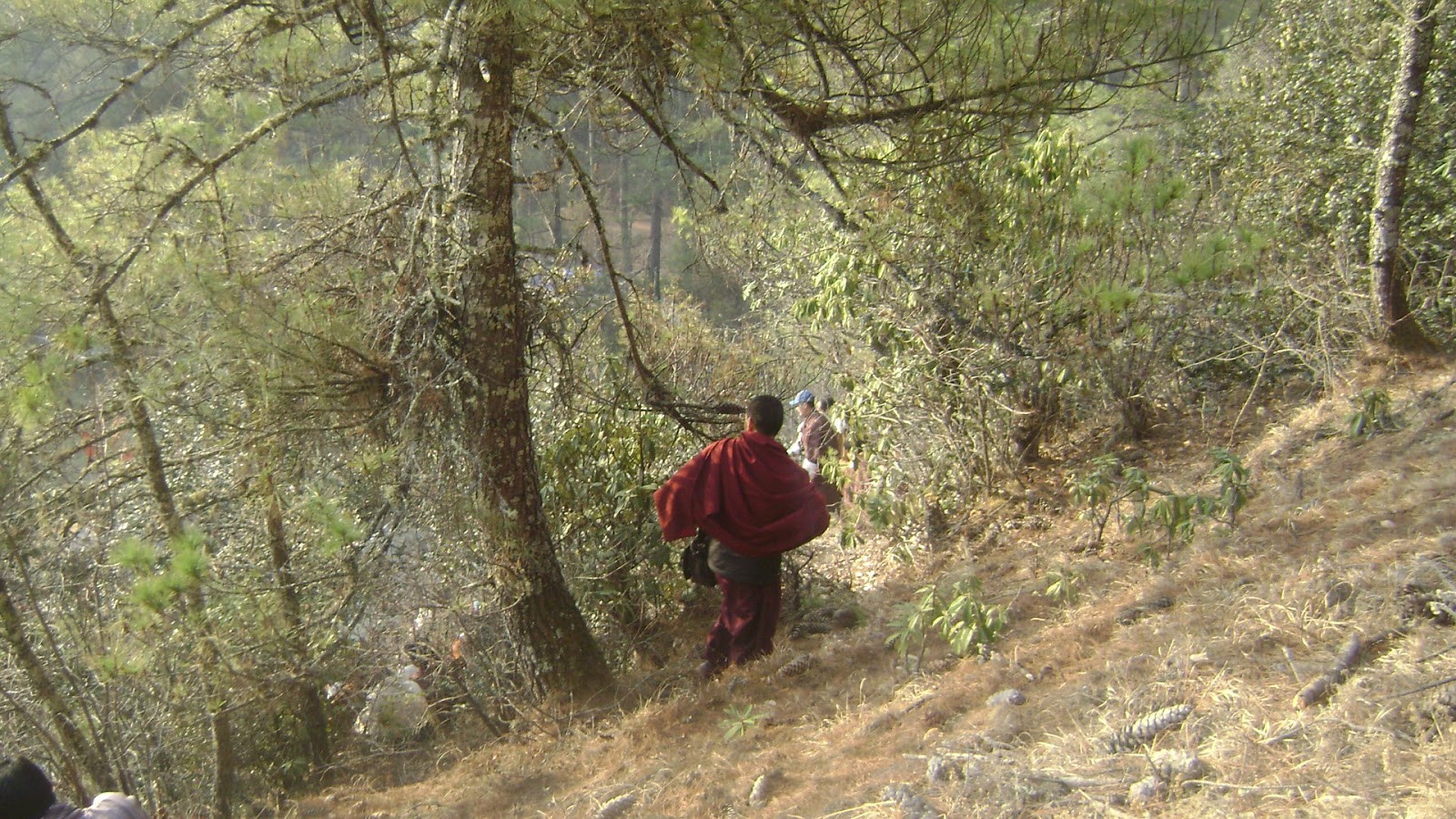
My classmate who had dropped out of school after sixth standard was sitting in my car. Karpola was his name. Yes, Karpola—which means "white"—though his face looked like it had been through a coal mine and then left in the dark for good measure. He had his own dark flashback of a life. He was coming for the first time to Thimphu, the capital city of Bhutan. All his life, he had been married to his village: Labar, Pema Gatshel. Sweating over keeping his dependents alive—farming, carrying heavy loads, and living in a dark home to match his dark face. A mundane, shit-stained life. The main reason for dropping out? Financial problems. Over and above that, he lived with his old stepfather—a professional alcoholic who regularly bet Karpola's mother in drunken card games. (I'm not joking. He actually put her as a bet. Lost her twice on Tuesdays.) Karpola had to take over everything. His mother's sole survival fell on him like a sack of wet rice.
But me? I had studied. I had a job now. We met after seven or so years. My parents' house sat on one lone hill; his sat over the next. We weren't overnight friends—we were infant friends. Same mud, same lice. After talking, he agreed to come for a break from what he called "over cowly life" in the village to Thimphu with me. Visiting Thimphu was his life's dream. And this could be the dream. He was bubbling over with excitement—and also with some unidentified gas from village beans.
We traveled one of the longest journeys. Most of the time, he slept inside the car, being ill from dizziness. On the way, he kept saying, "You overdrive." I overruled him. 50-60 km/hr was average speed, for God's sake. I wasn't racing a wild yak.
Near Thimphu city, we washed our faces fresh. I asked him to be watchful of his dreamland. For a better view, I drove him via Semtokha road. He opened his mouth. His tongue stuck out like a dying lizard as his eyes ran over every corner of the valley. Down the big lane—hundreds of cars, hundreds of crowded buildings. He pushed out, "Oh, over cars! More than cows in my village." I laughed. My bladder almost gave up.
We crossed Lungtenphug and saw the whole face of Thimphu. He looked at the city with his poking eyes, craned his neck through the car window like a turtle trying to escape. He looked arrestingly overwhelmed. "This is over beautiful," he noised into the air. "You misused the preposition," I said, laughing. "We say the most beautiful." "Anyway, this is over beautiful," he muttered. I gave up. Some battles are not worth fighting.
"We can see this place from outside," I fawned over him. "Let's check inside." I liked to lord it over my friend. We entered town, parked at the side of the road. Now the man from the uptown world was roaming the downtown world. We reached the farmer's market. I tried to paper over the cracks, but he had a habit of drooling over every nook and corner. That was where he got petrified. Somewhat allergic to his own dream. His face clouded over like a monsoon sky.
"This is over dirty," he announced. "Beautiful buildings, clean people, clean cars—but over dirty drains, over smelly, over wrappers, over papers, whatnot all over the places." He did me over as if I had personally hand-delivered this mess. I once again corrected him—this time with a sense of responsibility and shame for the place I had been fussing over. "You can just say dirty," I said. He looked at me like I had grown a second head.
My far cousin lived in Changjiji. We slept over for some days while I handled my spinning administrative works at the Education Ministry. Karpola, seeing all kinds of people, felt happy to mix in the mixture. I wanted him to experience city life. One night, we went over with a bang to a discotheque. Big mistake. We saw gangs of youth drunk, hauling over the coals, and soon breaking into a fight. A bottle flew past my ear. Someone's underwear was somehow on the ceiling. "This is over dangerous!" he cried. I lost my words. My intention was to show him another side of life—comfort, beauty, internal peaceful coexistence—but it turned all over. Karpola's habitual use of "over" put me in deep thinking.
The other night, I lay down on my bed and mulled over the word over. I doubled over with a hearty laugh thinking about it. But this wasn't a laughing matter. Was it? I came up with so many reasons. One could look externally beautiful but have dirty interiors—like a fancy hotel with a rat in the soup. The difference between "over" and "normal" was like having two faces of a person. Everything overly over is bad. Overeating? Bad. Overdrinking? Bad. Overusing "over"? Karpola was a walking lesson. But then again, over and over trying makes success. So maybe he was a genius.
After a week's stay, he decided to go home. He had a sort of hangover for his village. "My village is over normal," he said. He seemed head over heels in love with his countryside. I drew a veil over the subject. Karpola's eyes glazed over as if he was over and done with Thimphu's vigor. He got over with his dream—a rather betraying dream—and went back to his village. I didn't think he would be happy to spill over the news of his visit to his village mates. But knowing him, he probably told them Thimphu was "over dirty" and that I lived in a toilet.
I dropped him at the bus station. I had to return the next morning to Gedu. As his bus pulled away, he stuck his head out the window and yelled one last time: "You overdrive!" Then he was gone. I sat in my car for five minutes, laughing like an idiot. Then I drove back—at 50 km/hr.